CASE STUDY — OUR OWN WEBSITE
Empatix.it: our own website, treated like a client project
The website you are looking at is our first business card, so we built it the way we build our clients': from scratch, with no template, and with SEO, accessibility and speed decided before the design.
- Sector
- SOFTWARE HOUSE — OWN WEBSITE
- Year
- 2026
- Technologies
- Next.js · React · TypeScript · Tailwind CSS · Canvas
- Website
- empatix.it ↗ (opens in a new tab)
The context
A software house that offers custom websites and products cannot introduce itself with a template. The site had to prove two things at once: that we can build something recognisable, and that under the surface there is the same rigour we put into business software.
There was also a practical constraint: traditional shared hosting, with no application server always running. Instead of changing it, we took it as a rule of the project.
The goals
- A recognisable website, with no page that looks like a theme you have seen before.
- Fast and accessible even with animation and real-time graphics.
- Being found on Google for the services we offer, and being described correctly by AI assistants.
- Italian and English, with every page linked to its translation.
- Content that is updated by writing a text file, with no admin panel to maintain.
The solution
Everything static. Every page is generated ahead of time and served as a plain HTML file. No server assembles it on each visit: that is why the site runs on shared hosting, responds quickly and offers very little to attack.
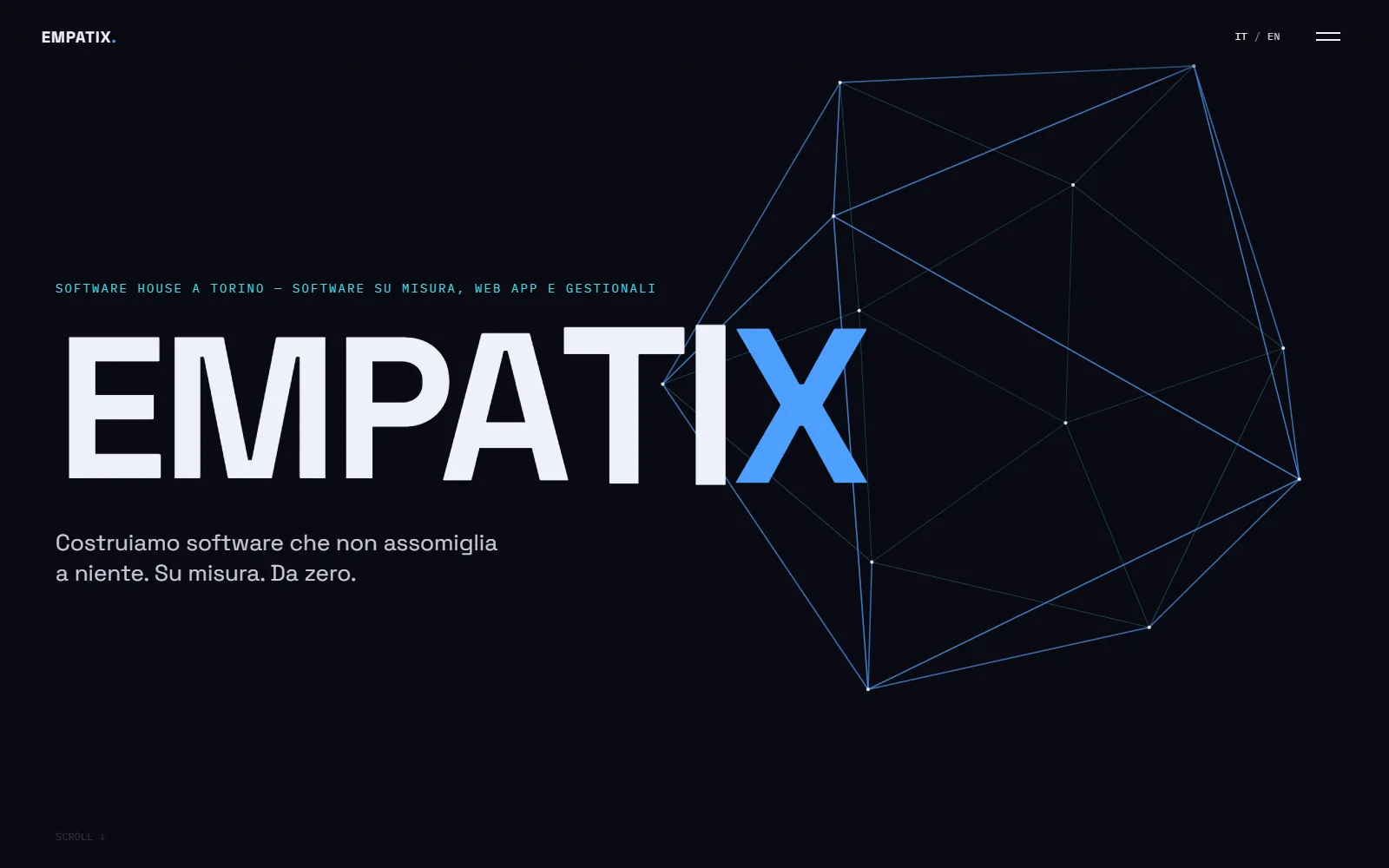
Hand-written graphics. The polyhedron on the home page and the animations are drawn directly on canvas, with no graphics or animation libraries: the site has six dependencies in total. Visitors who asked their system to reduce motion get a still version.
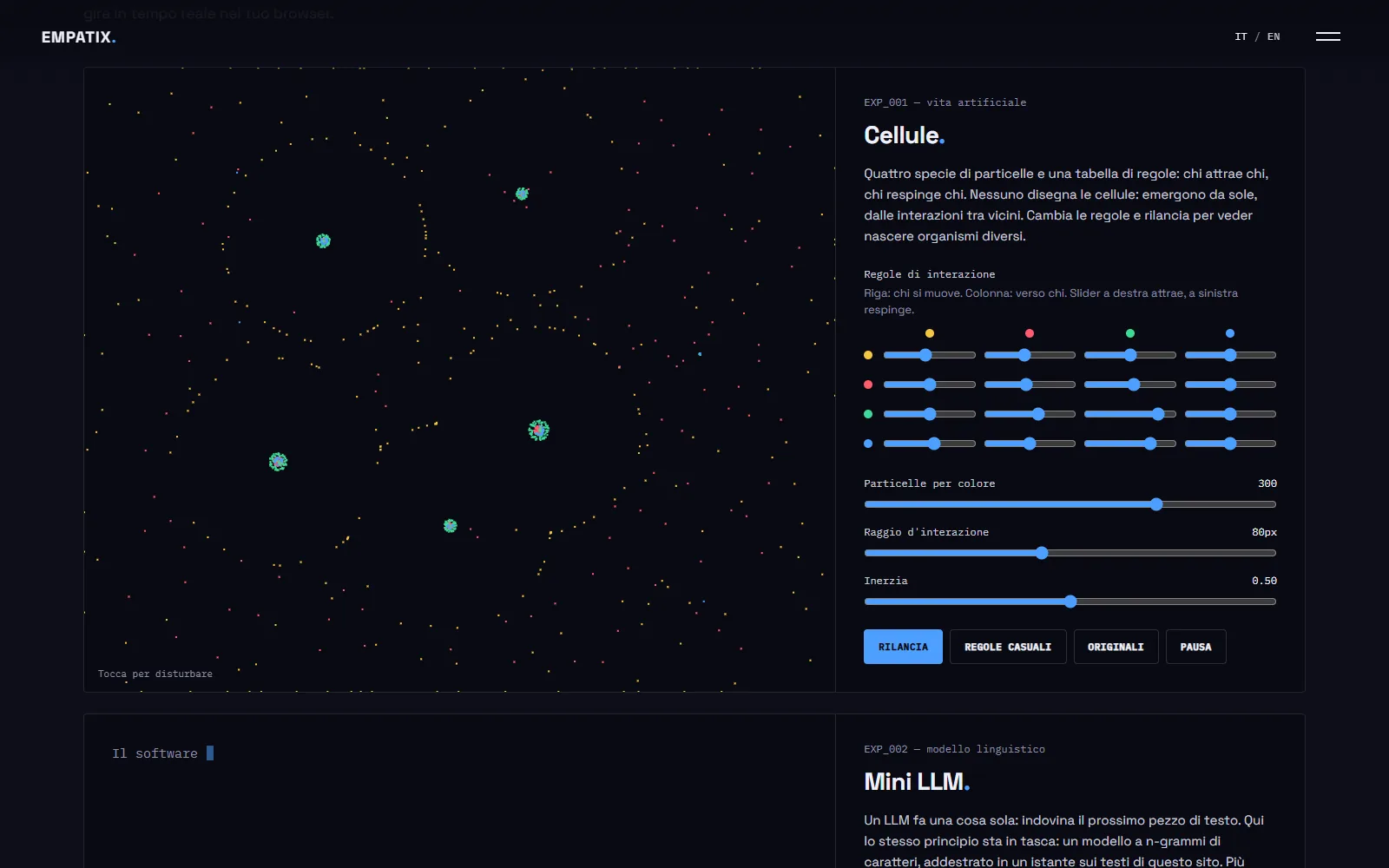
A Lab that actually works. Two experiments run in the visitor's browser: an artificial life simulation, where "cells" emerge by themselves from attraction rules between particles, and a small language model trained in an instant on the site's own text. They show what we mean by creative development instead of describing it.
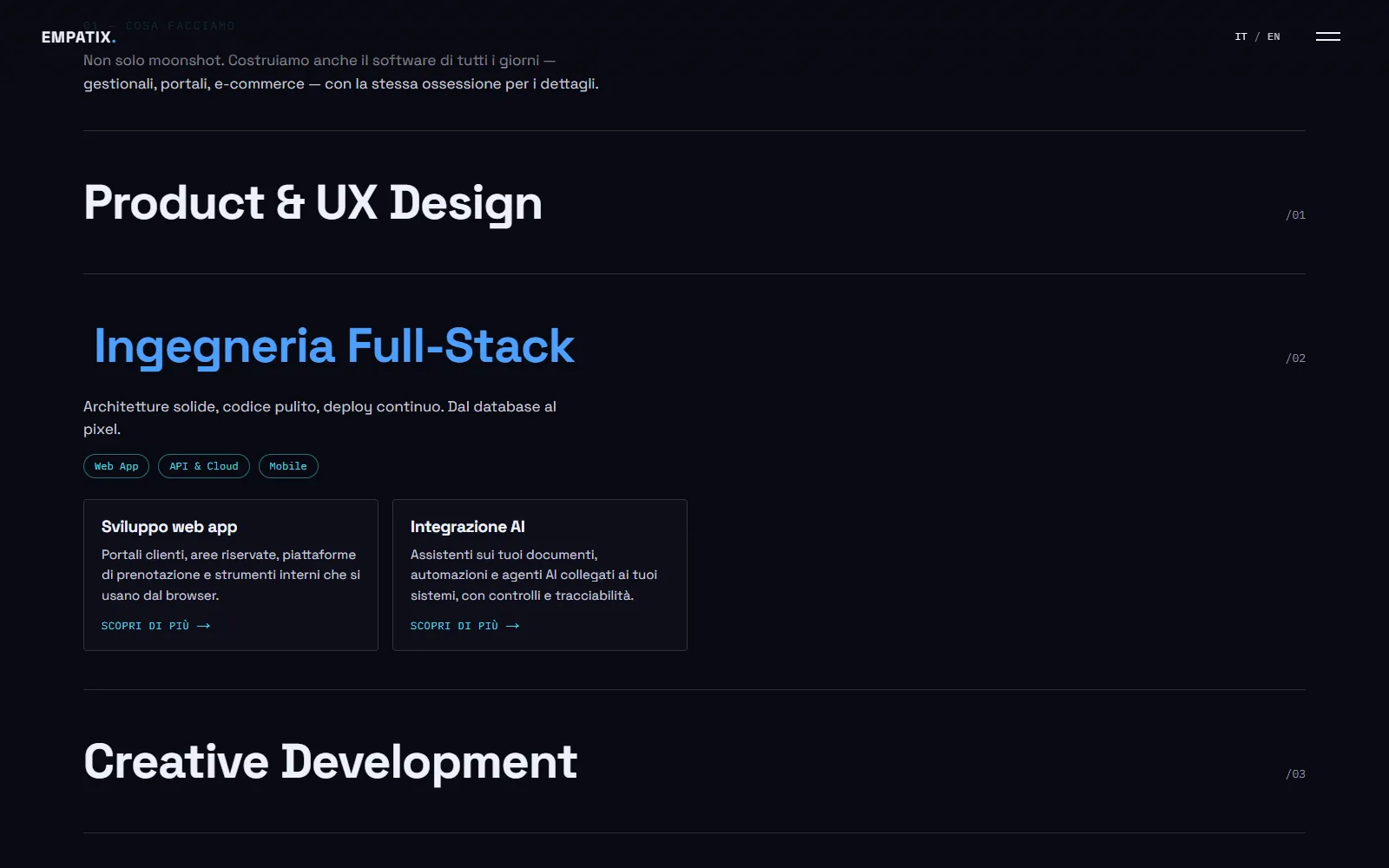
Services up front. The "What we do" section is an accordion that opens by itself as you scroll: each entry leads to the related service pages, one for each search a client might make.
Content in text files. Service pages, case studies and articles are Markdown files in the project. Adding one makes it appear by itself in the menu, footer, sitemap and archive, in both languages.
SEO and GEO
As with our clients' websites, optimisation lives in the code:
- structured data for the business, services, articles, frequently asked questions and case studies, generated from the same content that draws the page;
- a sitemap with real dates: for every page, the date its content last changed, taken from the project history. Never the release date;
llms.txtandllms-full.txt, the map and full text of the site for language models, regenerated on every build;- IndexNow: on every release, the search engines that support it are notified of the pages that changed, and only those;
- a single
h1per page, unique titles and descriptions, and every page linked to its version in the other language.
It is the same method we used for Dionisi Group, and it is part of our maintenance and growth service.
Privacy and accessibility
Analytics tools load only after consent; before that, no request goes to third parties. Interactive controls, from the accordion to the Lab sliders, work with a keyboard and are described to screen readers. The site has a light and a dark theme.
Releases
Every change goes through automated checks on code, types and build. Publishing starts by itself when work reaches the main branch: the site is generated, uploaded to the hosting and reported to search engines.
The technology
Next.js 16 in static mode, React 19 and TypeScript, Tailwind CSS, canvas for graphics and simulations, Markdown for content, GitHub Actions for releases. Apache server on shared hosting.
Results
The site is live at empatix.it and keeps evolving: this page is updated along with it. We will publish speed and visibility figures here once we have enough data for them to mean something.
Want a website built the same way? Start from creative development or get in touch.
Last updated: